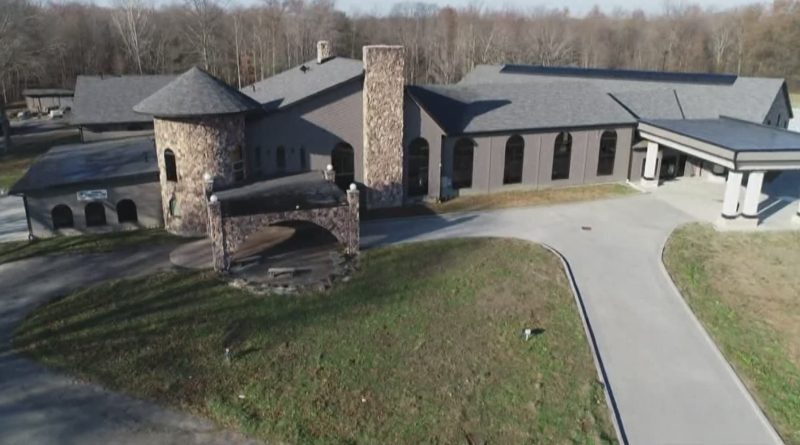
Abandoned Luxury Houses of Mike Tyson Mansion: The Wild Rise and Decay of a Heavyweight Palace
Few things captivate the public imagination quite like the total collapse of immense celebrity wealth. When a global icon reaches the absolute pinnacle of fame, fortune, and cultural dominance, their private residences often become the physical manifestations of their success. However, when that success violently derails, these properties transform into modern ruins. In the world of abandoned luxury houses, there is no single property that matches the sheer, opulent absurdity and haunting decay of the legendary mike tyson mansion in Southington, Ohio.
Built to accommodate the chaotic, high-flying lifestyle of the youngest heavyweight boxing champion in human history, this compound sat completely empty for decades. It became an absolute playground for urban explorers, a ghost story in the local community, and a stark testament to a turbulent era of celebrity excess.
To explore these abandoned mansions is to pull back the curtain on a legendary boxing legacy, a multi-million-dollar financial freefall, and the unexpected structural transformation that eventually saved the property from total demolition.
The Birth of Iron Mike’s Fortress of Solitude
To understand why this specific property stands out among America’s most famous celebrity estates, one must look back to the mid-to-late 1980s. Mike Tyson was an absolute force of nature. Under the guidance of legendary trainer Cus D’Amato and later the highly controversial promoter Don King, Tyson systematically dismantled the heavyweight division, capturing the world title at just twenty years old.
With unparalleled athletic dominance came an unprecedented influx of cash. Looking for a private sanctuary where he could train away from the media spotlight, Tyson chose a rural, isolated patch of land in Southington, Ohio. The location was deliberate: it sat just a short drive away from Don King’s primary training camp in nearby Orwell, Ohio.
Tyson purchased the estate and immediately spent millions transforming the contemporary structure into a lavish, customized fortress of 1980s luxury. For a brief window of time, the property was a bustling epicenter of late-night parties, high-profile entourages, and raw financial excess. It was a place where money was no object, and the design choices perfectly reflected the untamed, larger-than-life persona of “Iron Mike.”
Architectural Excess: Inside the Heavyweight Palace
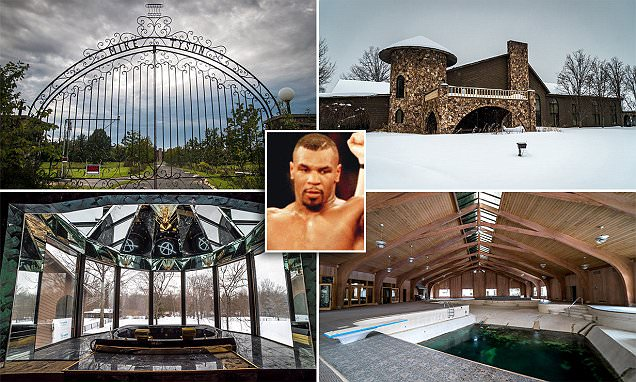
Spanning over 25,000 square feet of ultra-contemporary living space, the home stands as a flawless time capsule of 1980s architectural trends, prioritizing dramatic geometry, sweeping concrete structures, and hyper-customized luxury features.
Key Structural Specifications of the Compound:
- Total Master Suites: Five expansive, custom-designed bedrooms
- Bathrooms: Seven full bathrooms and three partial spaces, all outfitted with premium materials
- The Master Sanctuary: A multi-level bedroom suite featuring wrap-around mirrored ceilings and a sunken jacuzzi tub
- The Atrium Pool Complex: A massive, glass-enclosed indoor aquatic center designed for year-round entertaining
- The Tiger Sanctuary: Custom-engineered, high-security steel cages built directly into the backyard lawns
The interior design of the mansion was explicitly built to shock and awe visitors. The floors were covered in premium zebra-print carpets, rich white marble, and high-gloss black tiling. The main living areas featured soaring two-story ceilings, massive stone fireplaces, and floor-to-ceiling windows that looked out over the vast Ohio countryside.
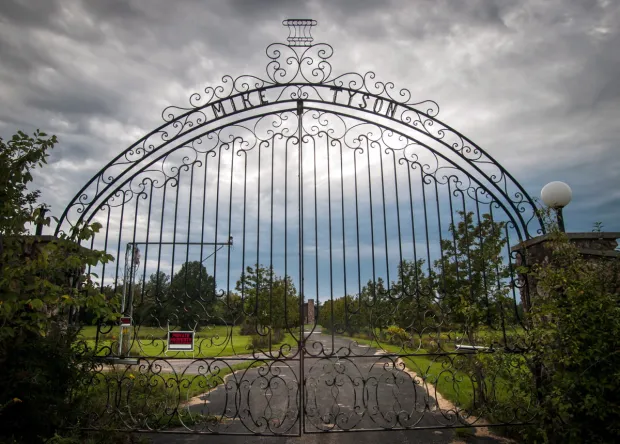
Nowhere was the excess more apparent than in the master bathroom. Tyson commissioned custom, 24-karat gold-plated fixtures for the sinks, showers, and toilets. The entire property was surrounded by a massive, high-security gate emblazoned with his initials, keeping the outside world firmly at bay while the heavyweight king ruled over his private domain.
Tigers in the Backyard: The Eccentricities of Wealth
What separates the mike tyson mansion from other standard abandoned luxury houses is the sheer eccentricity of the lifestyle it housed. Tyson didn’t just use the home as a place to sleep and train; he filled it with the bizarre trappings of unchecked wealth.
Most famously, the property served as the primary home for Tyson’s legendary exotic pets: three massive Bengal tigers. The champion spent thousands of dollars constructing professional-grade, steel-reinforced tiger cages just steps from his back patio. The tigers were regularly allowed inside the home, roaming across the marble floors and swimming in the Olympic-sized indoor pool.
[1989: Peak Champion Splendor] ──> [1992: Incarceration & Vacancy] ──> [1999: Forfeiture & Fire Sale] ──> [2005-2014: Era of Total Urban Decay] ──> [Modern Day: House of Worship]
However, this era of wild luxury was incredibly short-lived. In 1992, Tyson’s life and career suffered a catastrophic blow when he was convicted of sexual assault and sentenced to prison. The magnificent Ohio mansion, built to serve as a bustling champion’s sanctuary, was suddenly plunged into darkness. The tigers were rehomed, the entourage vanished overnight, and the grand limestone and concrete structure was left entirely vacant.
The Financial Knockout and the Path to Total Decay
When Tyson was released from prison in 1995, he attempted a major career comeback, but his financial situation was rapidly spiraling out of control due to years of reckless spending, high-stakes divorces, and legal fees. By 1999, desperate for liquidity, Tyson sold the Ohio compound to a regional real estate developer named Paul Monea for a mere $1.3 million—a fraction of what it cost to build and customize.
Monea, however, never truly lived in or maintained the property. He eventually became embroiled in a massive, high-profile federal money-laundering investigation, which culminated in his arrest and conviction. The mansion was seized by the federal government and locked behind legal red tape for over a decade.
Without any power, climate control, or basic structural maintenance, the house quickly fell prey to the brutal elements of Ohio winters. Water began leaking through the massive skylights, rotting the drywall and causing the iconic zebra-print carpets to grow thick layers of moss and black mold.
The transition from a multi-million-dollar celebrity sanctuary into a rotting ruin mirrors the heartbreaking architectural decline we documented in our deep dive into the history of Lynnewood Hall. In both cases, immense wealth could not save these massive structures from facing total abandonment once their owners encountered financial and personal ruin.
Anatomy of a Ruin: What Urban Explorers Uncovered
During the height of its abandonment between 2005 and 2014, the home became legendary within the global urban exploration (URBEX) community. Photographic records from this era offer a striking look at the sheer fragility of luxury.
1. The Green Pool Room
The indoor pool, once a sparkling center of entertainment, transformed into a scene from a post-apocalyptic film. Rainwater leaked through the rusted iron frame of the glass ceiling, filling the deep end with a thick, stagnant sludge of green algae. The high-end wood paneling along the walls warped and peeled away, creating an intensely eerie atmosphere.
2. The Stripped Master Suite
Vandals and trespassers eventually managed to breach the perimeter security, systematically targeting the home’s unique interior assets. The legendary 24-karat gold-plated bathroom fixtures were chiseled out of the marble vanities and stolen. The mirrored ceilings shattered onto the floor, leaving behind a stark, hollow shell of a space that once symbolized the height of 1980s wealth.
3. The Silent Tiger Cages
In the backyard, the massive steel tiger pens stood as rusting, overgrown monuments to Tyson’s eccentricities. Vines climbed up the chain-link fencing, and wild brush filled the concrete enclosures where apex predators once lived, symbolizing how quickly nature reclaims human excess.
Miraculous Resurrection: The House of God
Most abandoned mansions that suffer this level of intense water damage and vandalism are eventually condemned and demolished by local authorities. However, the story of this specific celebrity estate takes an unexpected, redemptive turn.
In 2014, the property was purchased by the Living Word Sanctuary Church, an evangelical congregation that recognized the structural potential hidden beneath the layers of decay. Rather than tearing the structure down, the church embarked on a multi-year, volunteer-driven restoration campaign to completely transform the champion’s palace into a modern house of worship.
According to historical coverage by local news outlets like WKYC News Cleveland, the massive indoor swimming pool area was successfully drained, filled, and capped with high-end flooring to serve as the church’s main sanctuary and auditorium.
The old master suites were converted into clean, functional classrooms for youth ministry, the commercial-grade kitchens were restored to feed the local community, and the overgrown backyard lawns were cleared to create expansive parking lots and peaceful picnic areas.
The Enduring Legacy of Abandoned Celebrity Estates
The cultural fascination with the mike tyson mansion highlights exactly why abandoned luxury houses hold such an addictive power over online audiences. These properties expose the intense vulnerability behind the illusion of celebrity invincibility.
When we look at a home built by millions of dollars completely surrendered to rot, we aren’t just looking at broken glass and peeling paint. We are looking at a physical reminder of how quickly the tides of fortune can turn. Iron Mike’s Ohio fortress stands as an unforgettable chapter in boxing history—a monument of pure 1980s excess that was thoroughly humbled by time, only to find a completely new purpose in its second life.
Pingback: The Carleton Island Villa: A Haunted Gilded Age Palace Left to Rot for a Century - Abandoned Files
Pingback: 5 Banned Tourist Places You Are Legally Forbidden from Visiting - Abandoned Files
Pingback: Inside the Facebook AI Experiment: The Day 2 Chatbots Invented a Forbidden Language - Abandoned Files