Inside Lynnewood Hall: The Tragic History of America’s Largest Abandoned Mansions
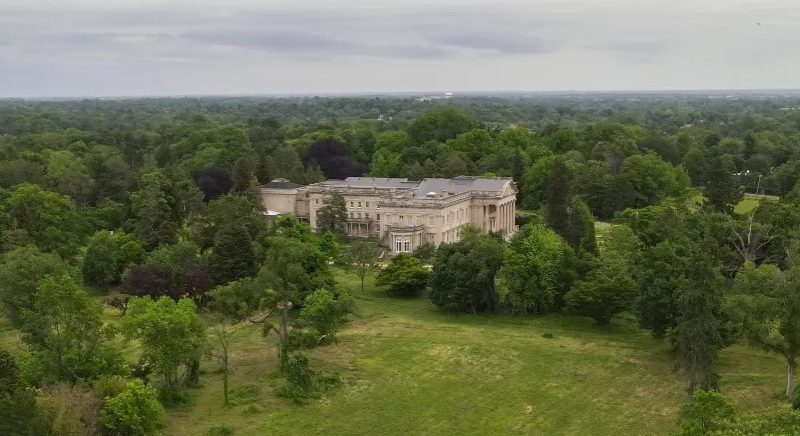
There is a distinct, haunting atmosphere that surrounds the world’s most magnificent abandoned mansions. When immense wealth, architectural genius, and historical significance are completely discarded by time, the remaining structures stand as hollow monuments to fallen empires. Among all the abandoned luxury houses rotting across the western hemisphere, none match the sheer scale, staggering cost, and profound tragedy of Lynnewood Hall.
Located in Elkins Park, Pennsylvania, this massive Gilded Age palace is widely considered the crown jewel of forgotten American estates. Spanning over 100,000 square feet, it remains one of the largest single-family homes ever constructed in the United States. Yet, for decades, its limestone walls have faced the elements in silence, guarded by security fencing and attack dogs, slowly yielding to the forces of nature.
To understand how America’s grandest palace transformed into an architectural ghost story, one must pull back the curtain on the Gilded Age history that built it, the devastating maritime disaster that cursed it, and the decades of legal warfare that left it to rot.
The Mastermind of Excess: Peter A.B. Widener
To appreciate why Lynnewood Hall belongs at the absolute pinnacle of abandoned mansions, one must first understand the staggering wealth of its creator. Peter Arrell Browne (P.A.B.) Widener was a true titan of the Gilded Age. Born into relative obscurity as a butcher’s son in Philadelphia, Widener possessed an uncanny instinct for infrastructure, long-term investments, and market consolidation.
During the American Civil War, Widener secured a highly lucrative contract to supply mutton to the Union Army. He systematically reinvested his profits into the burgeoning public transit systems of Philadelphia, eventually controlling the city’s vast streetcar networks. Recognizing the explosive growth of the late 19th century, he partnered with other financial barons to invest heavily in standard oil, public utilities, U.S. Steel, and global shipping companies.
By the late 1890s, Widener was one of the wealthiest men on the planet. However, immense wealth could not shield his family from heartbreak. In 1896, his beloved wife, Hannah Josephine Creighton, passed away aboard the family yacht off the coast of Maine. Devastated and seeking a grand distraction, Widener decided to uproot his family from their Philadelphia home and construct a massive sanctuary—a palace that would assert his family’s dominance in high society while serving as a private museum for his world-class art collection.
Architectural Genius: Building the American Versailles
Widener commissioned Horace Trumbauer, a brilliant and visionary young architect renowned for his masterful grasp of European classical design, to draft the plans for the estate. Trumbauer viewed the project as an opportunity to replicate the finest neoclassical traditions of Europe on American soil. Construction began in 1897 and concluded in 1900, requiring a literal army of master stonemasons, woodcarvers, and landscape architects.
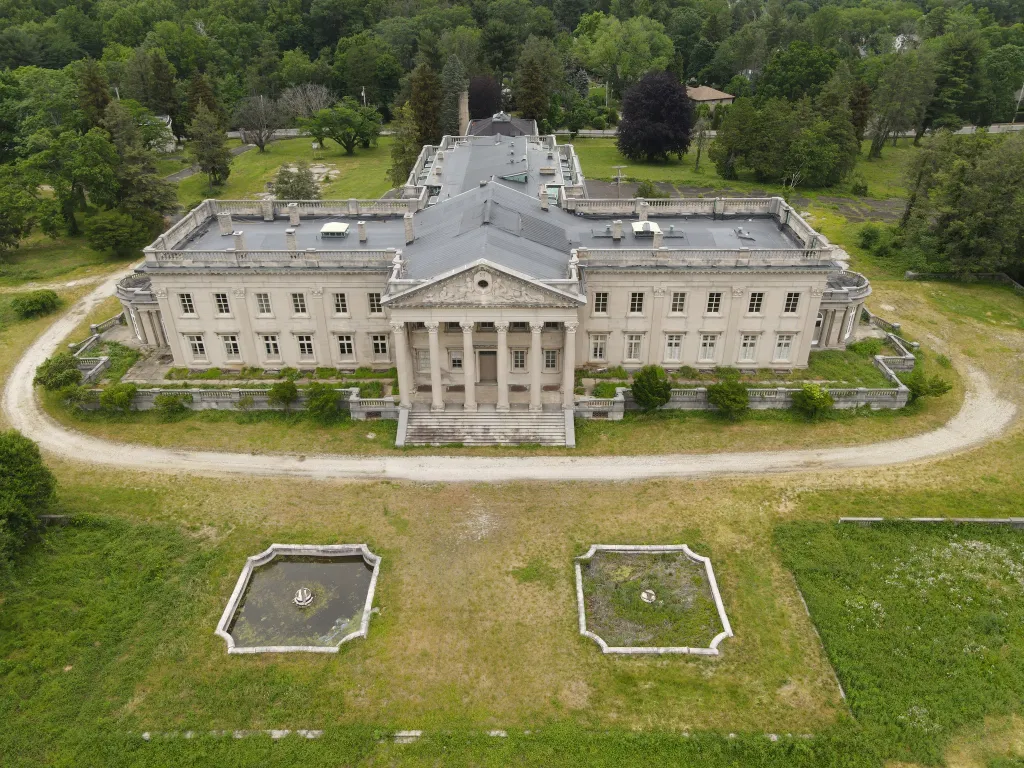
The resulting structure was a breathtaking, T-shaped masterpiece of Neoclassical Revival architecture.
Structural Layout of the Estate:
- Total Rooms: 110 palatial spaces
- Bedrooms: 55 expansive master suites and family chambers
- Bathrooms: 20 bathrooms outfitted with custom marble fixtures
- Dedicated Art Galleries: An extensive, secure wing designed to museum specifications
- Grand Ballroom: A massive space modeled after French royal courts, capable of hosting hundreds of elite guests
The exterior of the mansion was constructed using premium Indiana limestone, featuring a massive front portico supported by soaring Corinthian columns. Trumbauer explicitly modeled the facade after the landscape designs of the Palace of Versailles. The estate was surrounded by 48 acres of pristine, manicured lawns, formal Italian gardens, European fountains, and imported classical statuary sculpted by the world-renowned Henri-Léon Gréber.
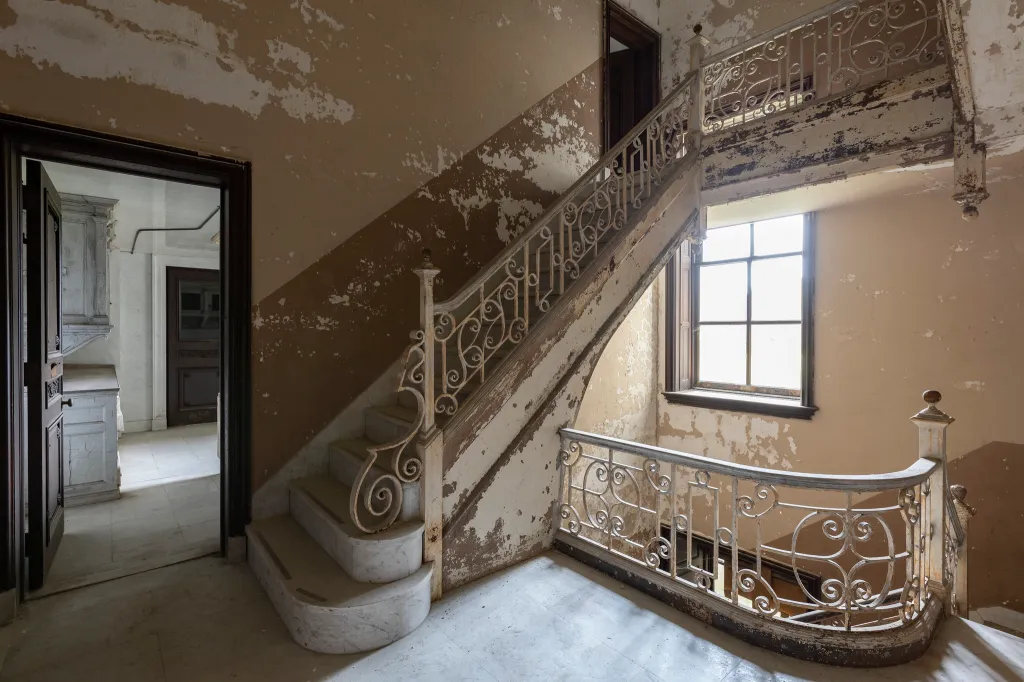
Inside, no expense was spared. The walls were lined with rare French walnut paneling, English oak, and metric tons of imported Italian marble. The grand staircase was a marvel of engineering, framed by solid bronze railings and rising beneath a massive, leaded glass skylight.
For a brief window of time, Lynnewood Hall was a vibrant, living epicenter of global wealth—but a dark cloud was rapidly gathering over the Widener legacy.
The Shadow of the Titanic: A Family Cursed by Luxury
As the first decade of the 20th century drew to a close, P.A.B. Widener’s health began to decline due to old age and chronic illness. Leadership of the family empire fell to his eldest son, George Dunton Widener. George, along with his wife Eleanor and their brilliant 27-year-old son Harry Elkins Widener, maintained the family’s passion for high society, global travel, and rare book collecting.
In the spring of 1912, George, Eleanor, and Harry traveled to Europe to scout international business ventures and secure rare literary texts for Harry’s expanding personal library. For their return journey to America, the family booked passage on a brand-new, highly publicized luxury liner owned by the International Mercantile Marine company—a shipping conglomerate that P.A.B. Widener had personally helped finance.
That ship was the RMS Titanic.
On the fateful night of April 14, 1912, the Titanic struck an iceberg in the frigid waters of the North Atlantic. Because the ship lacked an adequate number of lifeboats for all passengers, a strict policy of women and children first was enforced. George and Harry Widener gallantly assisted Eleanor into Lifeboat 4, remaining on the tilting decks of the sinking liner alongside their faithful valet, Edwin Keeping.
When the ship foundered in the early morning hours of April 15, both George and Harry perished in the freezing sea. Back in Pennsylvania, the aging P.A.B. Widener received the devastating news via telegraph inside the grand halls of Lynnewood Hall. The tragic loss broke the tycoon’s spirit. The massive estate, built to celebrate family continuity and triumphs, suddenly felt like a hollow, echoing mausoleum. Three years later, in 1915, P.A.B. Widener passed away inside the mansion, leaving the remaining family members to maintain the staggering property.
Decades of Decay: The Path to Abandonment
Following the patriarch’s death, the estate passed to P.A.B. Widener’s youngest son, Joseph E. Widener. Joseph was a passionate art curator who successfully transformed the mansion’s private galleries into one of the most important art collections in human history. The walls of Lynnewood Hall proudly displayed original, priceless masterpieces by Rembrandt, El Greco, Raphael, Donatello, and Vermeer.
However, the socio-economic landscape of the United States was changing rapidly. The advent of the federal income tax, followed by the catastrophic financial ruin of the Great Depression, made maintaining 110-room abandoned luxury houses an logistical impossibility for subsequent generations. The massive staff of regular servants, groundskeepers, security guards, and maintenance engineers required to run the estate began to dwindle.
When Joseph Widener died in 1943, none of the surviving heirs wanted to take on the astronomical tax burdens and operating costs of the mansion. The family made the difficult decision to permanently close the house. In accordance with Joseph’s wishes, the world-class art collection was donated to the National Gallery of Art in Washington, D.C., instantly stripping Lynnewood Hall of its interior cultural treasures.
What followed was a heartbreaking, multi-decade era of corporate neglect, strange owners, and predatory asset stripping.
[1900: Peak Splendor] ──> [1912: Titanic Tragedy] ──> [1943: Art Stripping & Closure] ──> [1952: Religious Sect Exploitation] ──> [Modern Day: Preserved Ruin]
In 1952, the property was purchased for a fraction of its construction value by the Faith Theological Seminary, an ultra-conservative religious group led by radio preacher Carl McIntire. The seminary lacked the capital required to maintain a delicate Gilded Age estate. To raise quick funds, the group began a systematic, tragic campaign of asset stripping inside the mansion.
Priceless French walnut paneling was ripped from the walls and sold to private collectors. Exquisite marble mantels were chiseled out of the fireplaces, and historic outdoor bronze fountains were sold off as scrap or ornamental decor. Large parcels of the original 48-acre estate were partitioned and sold off to developers, leaving the mansion isolated on a smaller, increasingly choked plot of land.
By the late 1990s, the seminary fell deep into bankruptcy, completely abandoning the structure. Water began leaking through the damaged roof, causing plaster ceilings to collapse, warping the historic parquetry floors, and leaving the grand ballroom to face the elements.
Anatomy of an Abandoned Masterpiece: What Remains Inside
Despite decades of severe neglect, vandalism attempts, and lack of climate control, the core structural integrity of Lynnewood Hall remains a testament to the unparalleled craftsmanship of the turn of the century. Urban explorers, historic preservationists, and architectural historians who have stepped past its heavy bronze doors describe an experience akin to entering a timeless bubble of arrested decay.
1. The Grand Ballroom
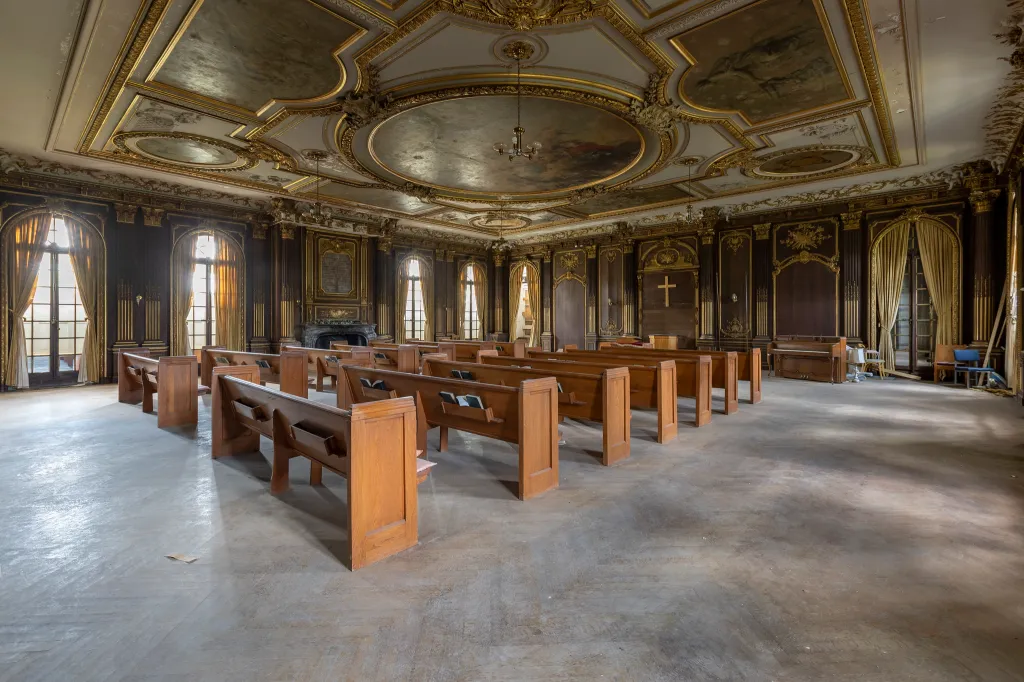
The ballroom remains one of the most jaw-dropping spaces within the estate. While the lower walls have suffered from moisture peeling away the paint, the soaring ceiling still features magnificent, hand-painted allegorical murals framed by intricate, 24-karat gold-leaf detailing. The sheer scale of the room shows how the Gilded Age elite danced under massive crystal chandeliers, completely insulated from the outside world.
2. The Art Gallery Wings
The long, vaulted gallery wings that once housed the world’s finest Rembrandts now sit completely empty. Skylights, designed to cast perfect natural light onto classical oil paintings, now leak rainwater onto deteriorating floors. The reinforced vault doors and complex early security mechanisms installed by the Wideners still stand open, offering a haunting look into the lengths taken to protect a multi-million-dollar art collection.
3. The Swimming Pool and Squash Courts
Deep within the basement lies a sprawling sports complex that was decades ahead of its time. The indoor swimming pool, framed by classical tiling, is now completely dry and covered in a fine layer of peeling paint chips and fallen plaster. Nearby, the original wood-paneled squash courts stand silent, their lines still visible beneath layers of dust.
Hope on the Horizon: The 2023 Rescue and Preservation Era
For years, Lynnewood Hall seemed destined for the wrecking ball. It sat firmly at the top of preservation endangerment lists, trapped in a seemingly endless cycle of real estate stalemates, skyrocketing restoration estimates, and zoning disputes.
However, the narrative surrounding this legendary icon of Gilded Age history took a monumental, hopeful turn. In June of 2023, after decades of meticulous campaigning by historians, the Lynnewood Hall Preservation Foundation (LHPF) successfully closed a historic deal to purchase the entire estate for $9.5 million.
“The goal is not to turn Lynnewood Hall into a private club for the elite, but to systematically restore its architectural majesty and open its gates to the public as a vibrant community asset, educational center, and historical museum.” — Lynnewood Hall Preservation Foundation
The foundation has already embarked on an expansive, multi-million-dollar restoration journey. Teams of specialized environmental remediation experts, structural engineers, and volunteer historical preservationists are working to safely remove asbestos, repair the compromised roofing structures, secure the perimeter, and halt the cycle of water damage.
Why Lynnewood Hall Obsesses the Internet
The enduring public obsession with Lynnewood Hall highlights why the abandoned houses niche holds such power over our collective imagination. These structures are more than just collections of brick, mortar, limestone, and decaying wood—they are physical manifestations of the impermanence of human ambition.
When we look at the ruins of a standard house, we see a personal story interrupted. But when we look at an abandoned luxury house of this scale, we are forced to confront a profound truth: that all the money, societal status, and earthly influence in the world cannot purchase immunity from tragedy, or save our creations from the slow, leveling hand of time.
Lynnewood Hall stands as a haunting reminder of the Gilded Age—a beautiful, tragic, and monumental architectural masterpiece that refused to disappear, waiting patiently in the shadows for the world to remember its name.
Read more about one of the most controversial video game of the history: 7 Reasons Why Manhunt 2 Became One of the Most Banned Video Games Ever Made – Abandoned Files
Pingback: Abandoned Luxury Houses of Mike Tyson Mansion: The Wild Rise and Decay of a Heavyweight Palace - Abandoned Files
Pingback: The Carleton Island Villa: A Haunted Gilded Age Palace Left to Rot for a Century - Abandoned Files
Pingback: The Tragic Ghost Castle of Belgium: The Rise and Fall of Château de Noisy - Abandoned Files